Search

Referral Banners
Tampilkan postingan dengan label Passing Game. Tampilkan semua postingan

Senin, 15 Juli 2013

4-Verticals and Some Rambling on the Passing Game, Part II

 Another post by my guest writer:

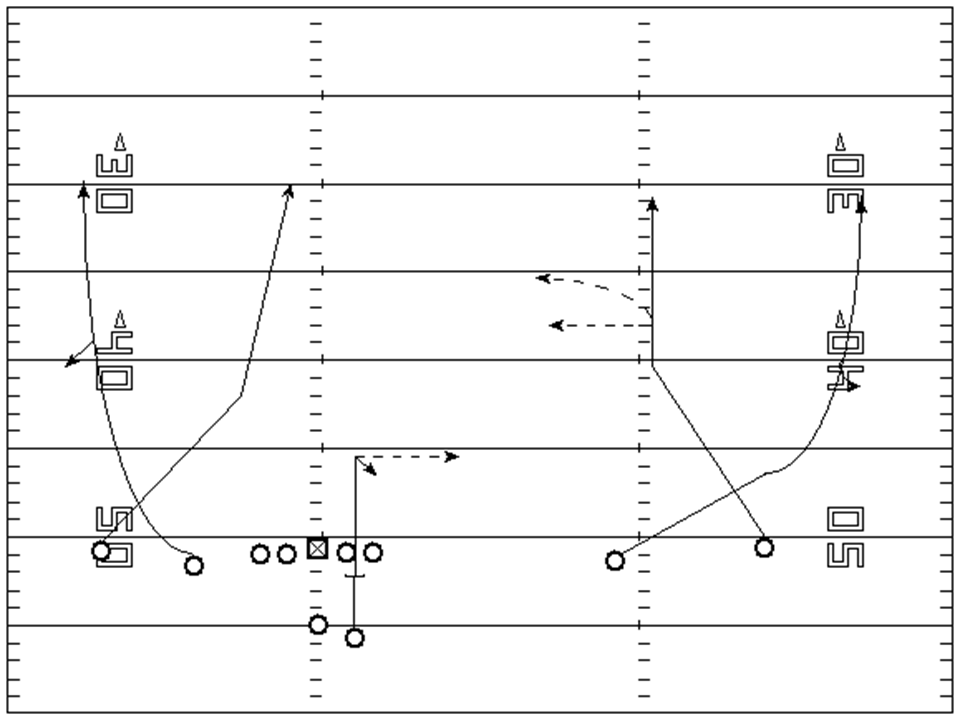
In Part I of this article, I wrote about how my offense coaches the Four-Vertical play as well as some different variations that could be created by simply tagging the base play. Previously, I focused on running the plays from a 2 x 2 formation, whereas now I will shift my focus into 3 x 1 formations. Please note that while the diagrams shown will be from true spread formations, attached formations can often yield effectively the same play. The key would be if an attached TE or Wingback can get to the same landmark as a displaced receiver and create the same spacing that the play requires. For example, if the ball is on a hash, a TE or Wingback into the boundary can execute the same assignment as a boundary slot receiver in a 2 x 2 formation. Another example with the ball on a hash would be to use a TE or Wingback to the field as the #3 receiver in a 3 x 1 formation.

The play-calling system for a 3 x 1 version of our Four-Vertical play is the same as in 2 x 2 formations: it starts with calling the letter of the player who runs the Locked-Seam. The slot receiver who is not running the Locked-Seam is still the Seam-Read. The outside receivers run a Stop or a Go route based on their respective Cornerbacks. Finally, the RB check-releases, and if he is able to release he runs a Dump route which breaks toward the Seam-Read if he is matched.

We will now start with our two basic versions of Four-Verticals before moving on to the different variations. In addition to talking about how the plays are run, I will also discuss why I would call one version over the other.


                When studying how different passing offenses run this play, you are likely to find the coaches split on which guy is their Seam-Read or “Bender” as it is often called. While there are advantages to each, I believe that it is best to have both options available in order to create the most stress against the defense you are playing against. In the above example, the Rhythm Locked-Seam is by the #2 receiver, and the Seam-Read is run by the #3 receiver. The way we would call this is by giving the letter of the #2 receiver before the play, such as “H-Verts” or “Y-Verts” or “Z-Verts,” depending on who the #2 is in that formation. Our QB’s basic progression is the same as it was in 2 x 2, only now both his Rhythm and Read routes are on the same side of the field. Should both of those routes be CAPed, the QB would then go to the RB on the Dump as his Rush route. The specific coaching points for the Seam-Read do not change, as his goal is to get into unCAPed and unoccupied space. He is still looking to get vertical down the field first, and if he is CAPed he will break on whatever angle is best to work into the open grass. This may end up being a Post cut, a sharp 90 degree Dig break, or something in-between. The key is avoiding collision from the LBs and working to the unCAPed space in a time frame that allows the QB to know where he is going and deliver the ball after one hitch.


                In the example above, the Rhythm Locked-Seam is run by the #3 receiver, and the Seam-Read is run by the #2 receiver. The way we would call this is by giving the letter of the #3 receiver before the play, such as “H-Verts” or “Y-Verts” or “Z-Verts,” depending on who the #3 is in that formation. Our QB’s basic progression is the same as it was in the previous example, only now the Rhythm and Read routes are run by different receivers. Should both of those routes be CAPed, the QB would then go to the RB on the Dump as his Rush route. The only thing that changes for the Seam-Read here is that he does not have a high-angle Post option because that space is occupied by the Locked-Seam. He is still looking to get vertical down the field first, and if he is CAPed he will make a sharp 90 degree break inside (Dig), or he can roll into something slightly deeper if the defense allows it.

                In order to maximize the effectiveness of your Seam routes in the Four-Vertical play, the first thing you should look to do is create a situation where you have the potential to hit an unCAPed Rhythm throw. Since our Rhythm route here is a Locked-Seam, our only chance to hit it is if he is unCAPed when the QB’s hits the last step of his drop. With this in mind, a coach should call the play based on which slot has the best chance to be open based on the pre-snap defensive structure.

                
     In the example above, the defense is showing a strong-side rotation into Cover 3. Traditional thinking is that you run the slots down the hashes and put the FS is in a bind. People have been doing that for years, and if that is how you do it and it works for you, then keep doing it that way. I used to coach the play like that, but since jumping into the world of R4, I learned that there were other ways to do it. The main reason in going away from defender keys is to eliminate the grey area. I could say to my QB “key the FS and if he goes right, you throw left, and if he goes left then you throw right.” Well, what if he doesn’t go anywhere? To eliminate hesitation by the QB (the main reason I was open to changing how I coached the passing game) he must have an initial plan of what he is going to do and something must force him to deviate from that plan. Instead of an “either-or” situation (which may not always be black and white), it is “throw the Locked-Seam on Rhythm unless you can’t, in which case you would move along in your progression.” Another benefit of the R4 system is the accelerated decision-making process. My QB has the potential to get the ball off faster since he is ready to throw the Locked-Seam at the end of his drop and without a hitch if it is unCAPed.

If both receivers were to run vertical in the example above, the #2 receiver is the most likely receiver to be unCAPed based on my pre-snap look. Granted, both receivers would have to avoid collision by the LBs, but #3 has the FS on top of him and inside. Traditional thinkers would say something like “Duh, the #3 receiver needs to get to the opposite hash so you can horizontally stretch the FS.” While that is the ideal end result, I again must go back to the principle of timing. The #2 receiver only has to avoid the rolled-down SS to enter into unCAPed space. The #3 receiver on the other hand must avoid collision by the Sam, as well as work across the FS’s face, where he may encounter the Mike. While a gifted receiver playing against inept coverage might make all that happen by the time the QB takes his drop (and a shotgun 3-step drop doesn’t take very long), it is likely that the QB would see the receiver collisioned or rerouted by the LB and have to move on in his progression. Regardless of what the FS does, collision and rerouting of receivers by the undercoverage throws off the timing of the play. This forces the QB to eliminate that route from his progression and move on to his next option if he is staying true to the timing of the play. These factors that help the QB make decisions faster are known as “accelerators” in the R4 system (for more information on the R4 accelerators, go buy the book). Maybe in 7-on-7 you can stay on a receiver indefinitely until he is open, but in real football there is a pass-rush, and those guys coming after the QB do not want to let him stay upright in the pocket for any period of time. Going back to the example above, if we make the #3 receiver the Read route, that receiver now has more time to work release moves, avoid collision, and then make a more distinct break to get to the unCAPed space. Bottom line is that by choosing the Rhythm route that has the best chance of success, you increase the likelihood of the QB being able to throw to him.
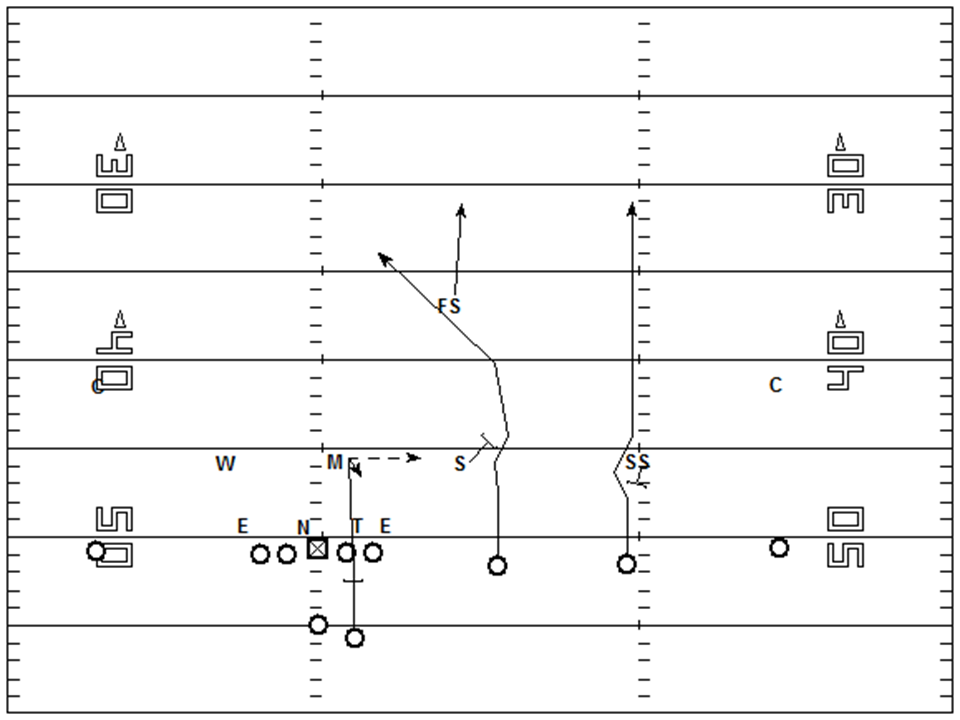


                In the above example, the QB drops back with the intent of throwing the Locked-Seam to #2 on Rhythm. If that receiver is collisioned, or the FS makes a drastic move to CAP him, then the QB will move his eyes and he hitches to throw to the Seam-Read. Again, being the “Read” route has given that receiver extra time to work himself around the Sam and into the unCAPed space near the hash. Should something happen to take away the Seam-Read (deep dropping Mike, hard-walling Sam, etc…), the QB will move his eyes hitch again to his RB on the Dump.


                In the above example we see a defense that appears to be in Cover 2. If both slots were to run vertical, which one has the best chance of being unCAPed? If you said #3, you are correct. Against the defense shown above, I would make #3 the Rhythm Locked-Seam, and #2 would be the Seam-Read. There are other many other ways to attack a defense like this (and we will look at some of those later), but this is the version of the base Four-Verts play that I would use.


In the example above, the QB drops back looking to throw the Locked-Seam to #3 on Rhythm. If that receiver is CAPed or collisioned, then the QB will moves his eyes as he hitches to the Seam-Read, which again has had the benefit of extra time to work himself around the Sam and into the unCAPed space between the Sam and the Mike. Should something happen to take away the Seam-Read, the QB will move his eyes as he hitches to throw to his RB on the Dump route.


                In the first two examples, we have seen defensive structures that were set up to allow the likely  Rhythm throw to be chosen pre-snap. There are also defensive structures that appear to not allow Rhythm throws. When this is the case, two things must be considered. These are if the CAP can be eliminated, and if not, what is the best Read route option?

     There are some cases where a pre-snap CAP can be eliminated post-snap. This can often be determined through film study (both coverage scheme and personnel), as well as in-game analysis (both scheme and personnel). Some Safeties will align with some cushion (8-10 yards) and dare you to try to run by them, and you can’t. Others will show cushion, but post-snap will allow you to get behind them. Personnel should be strongly considered, both offensively and defensively. Utilize your best personnel in positions that you think you have the best chance of winning. Remember, we are talking about the ability of a receiver to quickly close the cushion on a defender and be in a position to clearly get behind him in the time-frame of a Rhythm throw. It doesn’t do any good if the receiver needs 50 yards to run by a defender, because the QB will have long since moved on in his progression. 

     The next thing to consider when you cannot win on a Locked-Seam is which player/position has the best chance of winning on the Seam-Read. If you know that you won’t be throwing to the Rhythm route, it wouldn’t make sense to waste your best receiver there unless there was a ridiculous defensive overreaction that made it much better to throw to your second-best guy. Otherwise, the Rhythm route becomes a sacrificial lamb, and serves to give the QB a natural look-off as he allows his Read route to develop. (It should be noted that sometimes better Rhythm routes exist other than verticals, but for the purposes of this article we are sticking with a Four-Vertical concept. There are definitely times when you should just take a quick drop and throw the dang Hitch route if the coverage is playing 10 yards off).


                The example above shows a form of Quarters coverage with the FS aligning almost over #3. Assuming that you don’t anticipate winning on a Locked-Seam, your thinking should go to figuring out which player has the best chance to win on the Seam-Read. To determine that, there are a few factors to consider. First, does one safety look to be giving more cushion than the other? More cushion typically means softer coverage, and a less-contested throw. The next would be horizontal leverage. Outside leverage on an inside-breaking route is ideal, while heavy inside-leverage on the same break offers the defensive player a better chance to CAP the route horizontally. The third thing to look for is a possible bracket or disruption by underneath coverage. This could vary game to game, but hopefully a coach has an idea of how the underneath coverage of an opponent plays when they see vertical route stems. In the example above, both Safeties are giving the same amount of cushion, but the FS is much further inside of his respective receiver than the SS. So far the thinking is that #2 is the best option for the Seam-Read. Lastly, the alignment of the Sam being so far inside #2 indicates that #2 should have a free release and most likely will not have to worry about collision by the Sam.

                At the snap of the ball, #3 bursts down the middle of the field on the Locked-Seam. The FS drops back, CAPing that route. Seeing this, the QB eliminates the possibility of throwing the Rhythm route, and moves his eyes to find the window for the Seam-Read as he hitches to set the hallway for the throw. It is possible that the undercoverage could somehow take this route away, in which case the QB would move his eyes as he hitches again to the RB on the Dump as his Rush route.  


                The next situation to look at is a disguised secondary rotation. I am referring to a situation where the offense is totally fooled and has the play called to defeat the pre-snap look, only to have the defense change the coverage (and the CAPs) at the snap. The example above shows a pre-snap look of a Quarter-Quarter-Half coverage. You decide to use #3 as your Rhythm Locked-Seam.


                At the last second, the defense rolls into Cover 3. With the FS dropping to the middle of the field and the Mike walling off the Locked-Seam, the QB knows that this route is CAPed, and moves his eyes to the Seam-Read. The Seam-Read, upon recognizing the SS rolling down, knows that he is now unCAPed and continues vertical down the hash. The QB sees the adjustment by the Seam-Read as he hitches to set the proper hallway and fires the ball on a line to the #2 receiver. If something were to happen to the Seam-Read to prevent the QB from throwing to him, there would not be a Rush route available due to the RB having to block the blitzing Sam. In this case, the QB would be forced into an early release, which could either be a scramble situation or simply taking off and running for positive yards.


                Now that we have established the basic versions of 3 x 1 Verticals, the next thing to do is look at how tags can be used to create different variations. The one shown above is a strongside directional tag, and is the same tag discussed in Part I. The directional tag tells the QB that his Rhythm and Read routes will be the two left-most or right-most receivers (not always on the same side of the field). The play-call will include the #2 receiver called as the Rhythm Locked-Seam, followed by the directional tag (the example above shows a “Right” tag). As stated previously, the directional tag tells the RB which way to go on his Dump route if he is matched. A good time to use a directional tag is to create a horizontal stretch on an OLB (or a rolled-down Safety) in Cover 3 or Quarters coverage, or as a way to horizontally stretch a Cover 2 Safety. Even though OLBs in Quarters coverage don’t have to carry Seam routes, sometimes they get overzealous about collisioning the slot receivers, and do not get out to the flat. To take advantage of these players, we want to have the Rhythm and Read routes next to each other.

     In the diagram above we see the defense in a Cover 3 look. Hypothetically, let’s say the SS has been collisioning and running with the Locked-Seam by #2. In doing this, he is neglecting his flat coverage responsibility, therefore opening up the Stop route by the outside receiver. The QB will still take his drop and look to hit his Rhythm Locked-Seam by #2. If he sees collision by the SS, he will moves his eyes and hitch to throw to the outside receiver, who still will run his route based on the cushion of the CB. If the outside route is not there, the QB moves his eyes and hitches again to the RB on the Dump route.


                Here we have another example of a strongside directional tag (Right), in this case against Cover 2. The QB starts with his Rhythm route, which is #2 on the Locked-Seam. Something that was mentioned before is that the Locked-Seam does not deviate from his vertical track unless that ball takes him off of it. A Cover 2 Safety might play deep and outside of the Locked-Seam, and the QB could treat this as unCAPed and throw the Seam slightly inside. If the Locked-Seam is CAPed by the SS, the QB would move his eyes outside to the #1 receiver (who should outside release a hard CB and get vertical outside) and hitch to set his feet to the throw. As always, the directional tag would have the RB work in that direction if matched.


     While it is possible to use weakside directional tags to go from a #3 Locked-Seam to the Singleside #1 as the Stop/Go, it is not recommended for every situation. The above example shows a Quarters look with the Will in the box. This play would be called by using the letter of the receiver running the Locked-Seam, followed by the directional tag (Left in this case). The Rhythm Locked-Seam by #3, while it is possible that it could be open, does not do anything to affect the drop of the Will. However, the natural look-off created by looking at the Rhythm route could hold the Will in the box, and therefore open up the Stop route on the sideline. If the Will does end up buzzing out to take away the Stop route, the Dump route still has a chance, although he does not have nearly the same space he has when working toward the field. If your goal is to feed the ball to the singleside receiver and the Will is buzzing after reading pass, you may be better off signaling a Hitch (or Out) the pre-snap look is there and the quick throw does not give the Will time to get out to cover him.


                Here we see another weakside directional call (Left in this case) against a Cover 2 look. The idea here is to horizontally stretch the FS. The QB starts with his Rhythm Locked-Seam by #3. The possibility exists that it could be unCAPed. The final decision will be based on how the Mike and FS play post-snap. A Mike who walls deep creates a need to throw the ball further downfield, which allows the FS more time to react to the ball in the air. More on that later… Bottom line is if the Locked-Seam is CAPed, the QB moves his eyes and hitches to the boundary #1 receiver who will have read the coverage and run the appropriate route based on the cushion of the CB. Against a clouded CB, the receiver should attempt to outside release, but not get himself run out of bounds. If the CB widens to maintain his leverage, slip him inside, stack him, and get vertical. If for some reason the CB should bail and cover deep, the receiver still has the option to run a Stop route. If the outside receiver cannot win, the QB moves his eyes and hitches again to the RB on the Dump route.

     Back to the Locked-Seam against Cover 2- A coach with a really gifted QB could teach a back-shoulder throw, which creates more opportunities to stay with that route even if the Mike is running stride-for-stride with it. At the end of the day, the QB needs to have a set structure in place of how and when he can/should throw the Locked-Seam against Cover 2. I can provide a rigid definition of when to throw it, but that may cause you to miss out on opportunities to throw and catch some balls deep down the middle if your QB/Receiver tandem is very talented. If you know that you will have opportunities to call this route against a look like this, then it would be worth spending a little bit of time to figure out exactly what throws your QB can make and come up with your own guidelines, which will provide your QB with a structure he can be confident in working within.  


                Just like we saw in 2 x 2, a backside Shallow route can be tagged in a 3 x 1 set to give the QB a different Rush route. In this case, the #3 receiver should be the Locked-Seam in order to prevent the Seam-Read from being thrown working into the unoccupied defenders on the weakside (which would happen if #3 was the Seam-Read). The QB starts with his Locked-Seam by #3 as his Rhythm, and if that is CAPed, moves his eyes and hitches to #2 on the Seam-Read. If that isn’t there, the QB moves his eyes and hitches again to the Shallow route. Because the Rush route here is being run by a receiver, there is no risk of losing him in blitz pickup, which makes it great in the case of defensive pressure. Even if the defense does not blitz, the Shallow tag is a great way to hit an athlete on the run out in space when the coverage has dropped off to defend the vertical routes. This may offer a great chance at converting 3rd and long when the defense has softened to defend the sticks, and is now out of position to tackle your best athlete in the open field. A reminder that when a Shallow is tagged, the RB on the Dump route works to where the Shallow came from, and is sure to let the Shallow clear before working through the line of scrimmage (after checking for blitz).


                The last tag I’m going to discuss is a “Fin” route by the strongside #1 receiver. The picture created is essentially a “Levels” look. We want the Fin route to be adjacent to the Seam-Read, so the #3 is must be the Locked-Seam. QB starts here, trying to throw on Rhythm if it is unCAPed. If it is CAPed, he moves his eyes and hitches to #2 on the Seam-Read. If that isn’t there, the QB moves his eyes and hitches again to the Fin which is his Rush route. The RB’s job when a Fin is tagged is to check-release Dump and work away from the Fin route if matched. The Fin tag is a great adjustment when OLBs become aggressive in walling off Seam routes, or when OLBs let go of Seam routes when #1 runs the Fin route. It is also a way to guarantee a Rush route in the case of a blitz.

                I hope this article on the Four-Vertical play and adjustments gave you some ideas to incorporate into your offense. I have very few original thoughts when it comes to football plays. Pretty much everything I do has been borrowed or stolen from someone else, whether I realize it or not. I did not write this article for any reason other than I love to talk about football, I want to share what I know, and by writing my thoughts on computer it gives me a chance to articulate what is in my head. If you decide to use any of this stuff- great!  If not, I won’t know anyway so no worries. In either case, I only ask that you at least take an honest look at what you do and why you do it, and make sure that whatever it is you do, you are doing it as well as it can be done.   

Senin, 08 Juli 2013

4-Verticals and Some Rambling on the Passing Game, Part I

This post is by my guest author:

While I love coaching the physical run game as much as anyone, there is something to be said for chucking it around and creating explosive plays in the passing game. The Four-Vertical concept is one of the plays that I have had a lot of success with through the years, but I’m always looking for ways to make it better. For me, this play has evolved from something that I would only call against Cover 3 into something that my offense is going to really try to base our passing game on. I’m not saying I want to run the standard Four-Vertical play everything down. Instead I think you can use that as a foundation, with solid rules and skills that are mastered, and then building on that by adding simple tags and adjustments, I believe there is the possibility to attack almost any defensive coverage and create a plethora of different looks without changing a lot for the offense. I know what you are probably thinking now: “That sounds pretty cliché. Every coach says that his offense strives to be simple while appearing complex to the defense.” Give me some time to explain, and hopefully you will see where I am coming from regarding this concept.

Without further adieu, here is my basic Four-Vertical play:


***Using the R4 principles discussed in my previous article, I will now go through how my offense reads this play, as well as the different tags and variations that can be created. This article uses some R4 language and principles, but is not intended to replace the actual R4 book and DVD series. I would recommend that interested readers invest in those materials if they want to know more about R4.

On our basic Four-Vertical play and with all of our dropback concepts, we start with our Rhythm route. Here it is what we call a “Locked-Seam.” When we call this play, the player running the Locked-Seam is identified within the play-call (Y-Verts, Z-Verts, H-Verts, etc…). The Locked-Seam is a vertical route that does not have any adjustment (unless of course the ball takes him off his track). Our QB has a pre-snap clue of whether or not this route should be there based on the presence and depth (or “CAP”) of a safety. CAP is an acronym for Coverage-Angle-Personnel, and those are the factors in determining whether or not a receiver is open. The QB will then take his drop and confirm or react to the CAP of the safety (or lack thereof) and either throw the Locked-Seam when his back foot hits, or hitch to his next option. The sooner the QB can eliminate this throw, the sooner his eyes can move to his Read route.  

The second component of the basic play is what we call a Seam-Read. The inside receiver who is not tagged is the Seam-Reader. Like the name suggests, this is a “Read” route. We also call it a Seam-Read because it is a Seam route that has the freedom to read the coverage and adjust to open grass (or unCAPed space). We start with the idea that we want to win deep down the Seam. The receiver needs to read the presnap CAP, and make a post-snap confirmation or adjustment. Our base plan is to decide at 10 yards whether we can run by the Safety or not. If the receiver can win deep, he does. Depending on the leverage of the Safety, he could even run this route as a skinny post if that was his best path. If the  receiver can’t win deep, he breaks the route off inside at 12-yards and takes the best angle to open grass. This break can be influenced by the under-coverage. Against a hard wall, the receiver should execute a throw-by technique and break flat inside. If there is no wall or a trailing defender, the receiver can roll into his break and gain upfield slightly. The route may be different each time you run it, because the defense may be different. It is important that the receiver is able to recognize where the best grass is, and go there decisively. By the time the QB looks to the Seam-Read, he should have established where he is going to let the QB see where the ball should be thrown. I would recommend that the receiver you assign to run this route be one of your team’s best receivers.

The third part of the progression of the basic Four-Verts play is the Check-down to the RB, which we call a “Dump” route. Our Dump route will first check for blitz, and if there is none, he will work to a depth of five-yards in front of the QB. He will face the QB and sit if unmatched. If he is matched, he will work toward the Read route, which by default is the Seam-Read. We do this for a few of reasons. First, the QB’s eyes have an easy time working from the Seam-Read to the Dump route when they are in the same vicinity. Also, by working toward the Seam-Read the Dump route can help clean up the throwing lane to the Seam-Read.  Finally, if the Seam-Read is taken away by the LB inside him, that area is now vacated for the Dump route to attack. As mentioned before, a Rush route can serve as a check-down and is sometimes a quasi hot throw. On this play, our Rush route is a check-release route, and may be lost in blitz pickup. The QB must be aware of this fact and will elevate his need to scramble in a pressure situation.  

The final part of our basic play is the Release. The possibility exists for the three primary routes to be covered. If this is the case more than likely the coverage has dropped deep, and the Dump route covered by the MLB. This creates the opportunity for the QB to step up and take a wide-open running lane and sprint for big yards. That is our first choice if the protection holds up. If the protection breaks down, the QB should avoid the rush and look to release outside and work into a scramble drill. The importance of working a scramble drill often and against different scenarios cannot be said enough.

Now that the basic Four-Verts play has been established, I want to now talk about how we tag our basic play to create different variations.


This variation is the result of tagging the boundary slot to be the Locked-Seam. The field slot is now the Seam-Read. The RB check-releases and runs his Dump route which breaks toward the field if he is matched. Why would you call this version over the other? It may be the your strong-side slot is better at running the route, the Strong Safety does not cover as well, or maybe your QB likes throwing to the receiver breaking toward him rather than across his face. Other than that, the preference of who is your Locked-Seam and who is your Read-Seam is up to the play-caller.
  
Now we must talk about the outside receivers before the next tag is introduces. Even though we treat this play as a Four-Vertical concept, the outside receivers are not locked verticals. Our outside guys have a Stop or Go option based on the cushion of the CB, and are considered “Read” routes. They start with the intention of running by the CB, and if by 10-yards they feel they can win they will take it deep. If they are CAPed by the CB, they will break down at 13-yards and work down the stem and outside. Depending on the speed of the receiver, you may want to make this break slightly shorter or deeper. The key is the QB needs to see what the receiver is doing and be able to make the throw off one hitch step, so if the receiver is going to break down the QB would need to see that before he commits to the throw.


The variation shown above incorporates the outside receivers in what I refer to as a directional tag. If we call the play and give the QB a “Right” signal, that tells him he is working the right side of the field, Inside-Outside-Dump. This tag is useful in incorporating the outside receivers into this play when the OLBs become very seam-conscious (vs. Quarters or Cover 3) or as a horizontal stretch on the Strong Safety (vs. Cover 2). The directional tag overrides the RBs default route and he will now work to the called direction if he is matched. To recap, the Rhythm throw is the slot receiver on the Locked-Seam, if he is CAPed, the QB hitches to the outside receiver on the Read route, and if that is not there he moves to his Rush route (Dump). The directional tag does not affect the backside receivers. While the backside receivers are eliminated from the progression, they are still possible options if the QB has to scramble.


Building on the directional tag, we can change up the Rush route by tagging one of the backside receivers to run a Shallow cross. While these versions do not offer a true Four-Vertical look, I consider them part of the same family because our rules stem from the base Four-Vertical play, and involve only a small adjustment. These variations can create a drastically different look for the defense, and do so without changing much for the offense. The progression for the QB in the above diagrams is nearly the same as the regular directional tag, starting with the Locked-Seam, then to the Outside receiver on the Stop/Go, but now the Shallow serves as the Rush route. There are numerous advantages to using a WR on a Shallow as the Rush route instead of the RB on a Dump. The first one is it offers you a chance to keep the RB in for protection purposes if you are having trouble protecting the QB. It also provides an opportunity to involve a more athletic WR as your third option instead of a RB. The Shallow may also provide for a more explosive Rush route than the Dump. Our RBs are taught that anytime we are bringing a Shallow route from the backside, they let that receiver clear before they run their Dump route, and they will also work to where the Shallow came from if they are matched. The untagged backside receiver runs his normal route. As far as specifics of the Shallow route, there are different schools of thought on it. Some coaches want him full-speed across the field no matter what. Some coaches want him fast until he clears the far Tackle, and then throttling if open (vs. zone). I recommend using the method already found in your offensive system. If you do not currently run this route and want to put it in, I think the one where the receiver stays on the run is easier to teach.

By providing the outside receiver with a chance to adjust his route to win based on the CB, he has a chance to win against most looks, but there is some grey area that could make it difficult for this receiver to get open, especially to the wide-side. Some CBs will play over the top of the receiver with just enough cushion to not let the receiver get behind them, while at the same time anticipating a break-off route and jumping it. This, coupled with the long distance of the throw can make a contested Stop route unappealing, and the QB may pass him up. One way to combat this is with a called double-move by the outside receiver (as the Read route) with a directional call. Here the QB will look to throw his Rhythm route to the Locked-Seam like he normally does, but if that is CAPed he will hitch and throw to the double-move outside. The specific route you chose may vary based on what you run the most, but the main idea is that it should time up to where the QB can throw it off of one hitch. If the Read route is CAPed somehow, the QB will hitch again and look to hit the Dump route as his Rush. This could also be run with the Shallow as the Rush route instead of the Dump.  


Another double-move variation is a Corner-Post move by the slot receiver normally assigned to run the Seam-Read. This tag is useful against Safeties that overplay Corner routes or jump the first break by the slot. The QB has his normal Rhythm look to the Locked-Seam, and if that is CAPed he will hitch to the tagged Corner-Post (Read route). We run this route as 6-steps vertical, stick to the Corner for 3 steps, then back to the Post. The RB’s normal Dump rule applies, as he should work toward the Read route. Even though the QB is working through his standard progression, we don’t allow our Seam-Read to use double-moves unless tagged so the QB knows what he is doing and can make an accurate throw on time.


Another Rush route adjustment is to tag an outside receiver to run what is commonly referred to as a “Fin” route. This is a 5-yard In route that could settle if he finds a void. Coupled with the Seam-Read, these two routes combine to create a version of a popular play called “Levels.” In our version, the QB starts with the Locked-Seam as the Rhythm throw. If that route is CAPed, he would work to the Seam-Read as the Read route, and finally the tagged Fin is the Rush route. Just like with the directional tag and the Shallow tag, the Fin tag is a way to use a receiver to replace the RB as the third route in the progression. This allows the RB to stay in protection if needed, and guarantees that there will be a Rush route available in the event of a blitz. The Fin route provides an easy completion and is a way to make OLBs pay for aggressively walling off vertical routes. This tag can be to the field or boundary, but is called to the outside receiver away from the Locked-Seam. The only new teaching for the RB is that his route must work away from the Fin route. We want him to run a Flare when set away from the Fin, or if set toward where the Fin, he will work through the line toward the opposite Flat. This Flare route by the RB along, with the QB’s eyes looking at the Locked-Seam should get the MLB to open in that direction, therefore opening a nice window inside to hit the Seam-Read, or the Fin should the WLB wall that off. An important clarification is that a Fin route is very different from a Shallow route. The Fin pushes vertical to 5-yards (which could be a 7-yard vertical stem if that receiver is off the ball) and allows the inside receiver to clear before breaking inside. A Fin route can also settle in a void, and should be hit way before he gets to the Center. The Shallow route mentioned earlier is an immediate inside release and clear the Center kind of route, which will be hit outside the Tackle at the earliest, if not wider (remember, this is thrown after the QB drops and hitches twice).


This next tag is one that changes the Rhythm route from the Locked-Seam to a Shallow. The result is a picture that is similar to the old West Coast “Drive” play. Up until now, every tag used is given after the initial play call (Y-Verts X-Shallow, Z-Verts X-Fin, Y-Verts Right, etc…). When we want the QB to look at the Shallow first, it will be called before the normal Verts play name (something like X-Shallow Y-Verts). By calling the play like this, it makes it easy for the QB to remember, since the first thing we call is his first look (which in this case is the Shallow route). If the Shallow is CAPed, the QB hitches to his Seam-Read. If that is CAPed, the QB then goes to the RB on the Dump route. The RB has already been taught that when there is a Shallow route in the play, he will let the Shallow clear and then work to where that receiver came from. With the play diagram above, we can create a look that to the defense is an entirely new pass concept, but there is minimal change for our offense. Some coaches may argue that it is better to use a different name for a play if for all intents and purposes is its own concept, and they may be right (“If you are gonna run “Drive”, why not just call it “Drive?”). However, unless your QBs are studying old Bill Walsh tape, they probably have no clue what “Flanker Drive” is, and will learn your plays as whatever you decide to call them. Remember, what I wanted to show here is how you can create a very diverse and effective drop-back passing offense using a base play and tagging it to create different looks.


The last tag I will discuss is what we call “Switch.” Switch is a way to change assignments between two adjacent receivers. Depending on speed, you may need to shorten the break points (both inside and outside receivers) a little due to the receivers having to travel a longer distance to get to the same depth (geometry, triangles, hypotenuse…). This tag does require a fair amount of new teaching, but still is not difficult to incorporate into an offense. So why do you use the Switch tag? There are a few reasons, which depending on your situation may or may not include “Because I want more ways to tag Four-Verticals.” One of the ways good defenses will try to take away your Seam routes is by using collision and or rerouting the slots with the LBs. By switching the releases of your receivers, you make it much more difficult for the LBs to collision and or reroute your Seam routes, thus allowing those routes to clear the under-coverage much easier. This goes back to one of the basic principles of R4, in that if a route isn’t open when the QB is ready to throw it, the QB will move on to his next option. Another benefit of using the Switch tag is to create rubs against man coverage on the slot receiver. Still another benefit of running “Switch” is the ability to put receivers in different spots to do their same jobs or to allow them to run different routes that may help them get open. The use of the Switch tag can be a frontside thing to just change who the Locked-Seam is, could be a backside thing to change who runs the Seam-Read, or you could Switch both sides (shown in the diagrams above). In addition, by incorporating the other tags explained earlier a play-caller has a ridiculous number of variations that the offense can easily execute.


This concludes Part 1 of what I hope is a 2-part thing on the Four-Verticals play and tags.  I look forward to going into 3 x 1 variations next time. 

Jumat, 05 Juli 2013

Some Rambling on the Passing Game and a Brief Overview of the R4 Progression System

My guest author has contributed another article:

It is time again for me to give back to the coaching community that I am so grateful to be a part of. I love going online and searching for articles and videos to help me learn more about the game. Sometimes I even stumble upon something that I thought I invented (OK, that happens a lot). With that being said, everything I’m about to talk about has roots in something that other coaches before me came up with (or maybe they stole), so don’t hate me if this article is not anything revolutionary. My goal here is to help out my buddy Coach Hoover in creating material for his blog, and to share some of my research/creations.

This piece I’m writing now is sort of a preface to the next thing I will write on my Four-Vertical package. I want to share some thoughts and establish some terminology to make the next piece easier to understand. A lot of this stems from me incorporating the R4 system into my passing offense. As many of you know the R4 system is a something that any coach can incorporate to streamline his passing game. When I read the message boards (Huey) it almost seems like knowledge of R4 is a requirement if you are coaching the passing game.  In addition to the progression system, there are also other components of the system that can help coaches, and as a result, help QBs improve their play.

I think it is pretty cliché for coaches to say that they are always striving to get better. But are they really? Are they willing to take an honest look at what they do, how they do it, why they do it that way, and then make wholesale changes if that is what the situation calls for. I’ll admit that it can be difficult for me to make big changes. I have been an Offensive Coordinator for four years. During this time I have had four different starting QBs. Each of those QBs brought a different skill set to the table, and experienced success. Each QB completed around 60% of his passes, and rarely threw interceptions. While I love the low INT stat, I think it was no coincidence that each QB was hesitant and indecisive when throwing to a receiver who wasn’t wide open. None of the QBs were good at throwing to receivers right out of their breaks into open grass. Four different guys, but yet somehow they all shared these traits. What could it be?

The one constant in each of those four seasons was me and how I coached them. It was my coaching, or lack thereof, that caused these QBs to hesitate and not throw with great timing and anticipation. Since we have been fairly successful on offense, it would be easy to just stick with the status quo since we were moving the ball OK and not turning the ball over. As we all know, easiest isn’t always best. There had to be a way to help my QBs get better and more aggressive with their passes without putting us at risk for more interceptions. Basically, I was looking for a way to coach better. This is where the R4 system came in. I am not writing this article as an endorsement for R4, and in fact I haven’t even coached it for a season to be able to speak from experience. What I do know is how the system forced me to look at how I do things, and how I could do them better. My goal here is not to sell you on the system, but instead use it as a medium in which to communicate. This article is about establishing a system of communication, which will allow me to then talk about how my offense coaches the Four-Vertical play.
  
There are many components of the R4 system that have to do with pre-snap looks and accelerating the QBs decision-making process. If you are interested in learning that, check Huey or get the R4 book. I want to focus more on how the R4 system of building a read progression has influenced my play design. This assumes that the QB already has a solid foundation of throwing mechanics and footwork.

As far as the throwing progression goes, it all starts with establishing a “Rhythm” throw. The Rhythm route is the first option for the QB, and is designed to be thrown on the last step of the QB’s drop. Ideally, this is a route that has a chance to win deep. Examples of vertical Rhythm include Seams, Fades, Posts, Corners, and non-vertical Rhythms include Speed-Outs and Spot routes. For timing purposes, the QB must make this throw when his back foot hits, or he will move on to another route in the progression. With this in mind, route breaks must be set up to allow for this timing to work. For example, if your QBs back foot hits and your receiver is on his 7th step, then that is when your Post route should break if you want to throw it on rhythm. Just because Spurrier has his post route break at 15 yards doesn’t mean that is what you should do. It is all about syncing the route break up with the QB’s drop.

If and when the QB eliminates his Rhythm route, he moves his eyes and hitches (or resets his feet) to the second part of the progression is called a “Read” route. These are longer-developing routes, which allows for deeper vertical stems, multiple breaks, get-open routes, or double-moves. Examples include Curls, Digs, Post-Corners, Corner-Posts, and Out-n-Ups.

The third part of the progression that the QB goes to if the first two options are covered is called the “Rush” route. Rush routes include a wide-variety of routes that function to stretch the coverage (often opening up Read routes), offer the QB a place to get rid of the ball if pressured (or rushed), or as a check-down route to get the ball out of the QB’s hand when his downfield routes are covered. Examples of Rush routes include Flat routes, Flares, Shallow cross, and RB Check-downs.

The final component of the R4 progression is called “Release.” The by-the-book R4 system allows for three primary routes in the progression, then the QB is instructed to release, or look to get out of the pocket. Depending on the protection and or pass-rush, the release could be as easy as stepping up in the B-gap bubble and scrambling for yards, or could be a move to break contain and get to the perimeter. This is a part of the progression that is often overlooked, but is critical for avoiding sacks, and extending plays to move the chains or hit explosive plays downfield. The release plan could vary from play to play, but the QB should be given some instruction about where he should try to go if the protection breaks down. A daily scramble drill period will help to train the QB to not sit in the pocket forever, and also to train the receivers to recognize that the primary play has broken down and they need to adjust to help the QB.

 Now that I have established the basic components of how an R4 passing progression is built, I will use this structure to look at how these principles can be applied to the Four-Vertical play. Part one of a two-part series should be posted very soon.

Great Links:

The Mother Lode of Zone Running Game Resources  (go ahead and add this to your list 
of Favorites)

Creating Explosive Plays in the Passing Game - Dan Gonzalez