Search

Referral Banners
Tampilkan postingan dengan label Fire Zone / Zone Blitz. Tampilkan semua postingan

Kamis, 29 Maret 2012

Wide Cross Inside Fire Zone

I added the coverage adjustment to this post on 3/29/12.  Thanks again to the Anonymous comment that pointed this out on the video.

The Wide Cross Inside Fire Zone is a great way to get pressure right in a QB's face. The picture below is a page from Dick LeBeau's 2002 Bengal playbook:
2002 Cincinnati Bengals 3-4 Defense - Dick LeBeau.pdf


Backer and Core refers to the Force players on each side (the Sam LB and Elephant DE).  The play is drawn with the Nose in a 2i, but he is often in a Shade/1 tech in the cut-ups (just as long as he can get out of the way quick enough).  The Buck LB will go first and the Mike will go second.  Someone on Coach Huey asked about the difference between Cover 3 and Cover 3 Fire for the Corners. The difference is that the Corners don't midpoint the number one and two receivers going vertical in 3 Fire coverage as they do in regular Cover 3.

If the Corners aren't helping out vs. the #2 WRs, wouldn't this leave the FS out to dry vs. 4 Verts? Well, the key is with the Seam/Force players. Dick LeBeau teaches these players to funnel the #2 WR inside towards the FS. Blitzology explains this in more depth here and here.

The first three cut-ups show adjustments that the Steelers make to their Fire Zone coverage to improve the coverage as well as the leverage of their Force player.

Cut-up #1 - The Steelers pre-snap will plan to run their Fire Zone coverage the same way that it is drawn in the playbook diagram since #2 is a TE to Field.


Cut-up #1 - The RB motions and becomes the new #2 so the Sam and SS switch coverage assignments to help improve their Fire Zone coverage. Also, it helps the run defense to where the SS Force player has outside leverage on #2. The Steelers will make this adjustment anytime #2 is lined up wider than a TE.


Cut-up #2 - A WR is split wide as the #2, so the SS and Sam switch.


Cut-up #3 - #2 is lined up wider than the TE, so the SS and Sam make a call to switch.


Cut-up #3 - #2 motions away and the TE becomes the new #2, so the SS and Sam switch back the coverage.


Keep an eye on the coverage adjustments as you watch the cut-ups which are from the 2004 Steelers vs. both the Pass and Run. It is a great Fire Zone vs. both.


Sabtu, 11 Februari 2012

Bench Wren

Louisville Head Coach and former Florida Defensive Coordinator Charlie Strong is a man who has ruined the National Championship aspirations of two Heisman Trophy QBs, Troy Smith and Sam Bradford.  He teaches that Fire Zones should attack the Offense from three different areas: Field, Middle, and Boundary.  My previous Fire Zone posts have shown pressure being brought from the Field and in the Middle and this post will show a good example of a Boundary pressure used by blitzer extraordinaire Jon Tenuta, current N.C. State LB Coach and formerly the DC at Notre Dame, Georgia Tech, UNC, Ohio State, SMU, Kansas St., and Marshall.

These are newly posted clinic notes of mine with good info on Tenuta's blitz schemes from 2006: 2006 Atlanta Nike Clinic Notes (Pat Hill, former HC at Fresno State was a great speaker at that clinic as well).   Manny Diaz, another coach that I have studied, mentioned Tenuta as a guy he admired for being relentless in bringing heat and having success with lesser talent than the rest of the ACC while he was at Georgia Tech.

Tenuta's attention to detail is readily discernible while listening to him speak passionately about getting after the QB.  He strongly emphasizes the aiming points of his DL and the departure angles of blitzing LBs and DBs.   He devoted 10-15 minutes a day as a DC to practicing these aiming points and departure angles with his Blitzes and Fire Zones.  He likes his outside blitzers to be the quick Force players and for their departure angle to be one yard outside of the nearest or deepest RB.  Departure angle is talking about his initial angle, but as a Force player it is important to be able to adjust that angle and stay outside the RB.  Let me show a quick example of how this works before I get to the Bench Wren Fire Zone I am supposed to be writing about.

This is the NCAA blitz or America's Fire Zone (Bench Falcon in Tenuta's playbook) and these are the run fits to the Field side: long stick DE - A gap, scraping Mike - B gap, 3 Hook Will - inside 1/2 of C gap, 2 Seam SS - outside 1/2 of C gap, and outside blitzer Sam - Force.  Many DCs prefer their Outside Blitzer to be a Spill player and for the 2 Seam player to always be the Force player.  To be honest with you, I don't know why Tenuta does it this way.  It could be preference or personnel or both.

Bench Falcon

Here is Bench Wren below.  The Bench call sets the FS, Will, Fox DE, and 3 technique DT to the Boundary.  The video calls it Bench Wren 3 Blaze, that's a term I used to tell the Safeties to rotate to the Boundary.  It can be a helpful tag if you are a Field and Bench pressure team, but I now prefer Manny Diaz's system of calling Field or Boundary to the side of the call, which tells everyone where the blitz is coming from.   It also tells the Safeties which way to rotate and tells the front how to line up.

Bench Wren

Both LBs will walk up on the line of scrimmage and show blitz.  The Will LB is the Outside Blitzer and Force player with a departure angle of one yard outside the nearest or deepest RB.  The Bench Tackle and Fox DE are executing what is commonly referred to as a "Tex" stunt, with the DT going first and then the Fox DE looping behind him and into the A gap.  The DT's aiming point is the inside ear hole of the OT.  He is the B gap player and wants to get up the field.  The NT gets in a heavy shade on the Center and slants to the inside ear hole of the Guard.  He wants to draw the Center's attention to create space for the Fox DE looping inside.  

The 5 technique DE is aiming for the inside ear hole of the TE.  He is a C gap player vs. the Run, but he must cross the TE's face vs. the Pass and be the Contain rusher.  The Mike LB is the B gap player and the Sam / Nickel is the D gap and Force player vs. the Run to the Field side.     


Here are some cut-ups:


Blitzology also did a post on this blitz concept here.


Looks like someone made a playbook app: here.  Thanks for the info - John from Coaches Corner.

Sabtu, 14 Januari 2012

Strong Scrape Fire Zone and Fire Zone Adjustments

How many times have you been to a clinic and heard a speaker talk about America's Fire Zone? Too many times, probably. It's not like there are only a limited number of pressures that you can run (Blitzology with proof of that on his site here).  I will talk about America's Fire Zone, but I will use it as an example of how to make Fire Zone adjustments.  Dick LeBeau refers to this as Strong Scrape Fire Zone in his 2002 Bengal playbook here.


The Strong call tells the defense to run this Fire Zone to the side of the passing strength or the 2 WR side, either a TE and a WR, or two WRs.  Many teams also will call it to the wide side of the field with a Wide or Field call or to the boundary or short side of the field with a Short or Bench call (see Manny Diaz Fire Zone article here for diagrams). The Fire Zone is called Scrape because of the assignment of the Buck LB, who must scrape tightly off the butt of the DE so as to not allow a crease in the defense.

I won't get into the techniques of each position so the clinic guys have something to talk about this clinic season, but I want to talk about the adjustments that are important to run this Fire Zone effectively.

I have borrowed a lot from Manny Diaz when it comes to Fire Zone adjustments.  There are many adjustments that can be run, which include having the DT being a dropper at times, but there are two adjustments that I think are the most important.  Diaz talks about how the coverage needs to be the easiest thing as far as Fire Zones go, so it is important that we not over-complicate things.  If a defender blitzes the wrong gap, you may have a bad play but it won't be a disaster.  Now, if there is a mistake in coverage, that's a disaster.  

The great thing about the teaching of these adjustments is that only the Will LB has to think about the checks (this would be the backside Mike LB in LeBeau's defense).

Fire Zone Adjustments

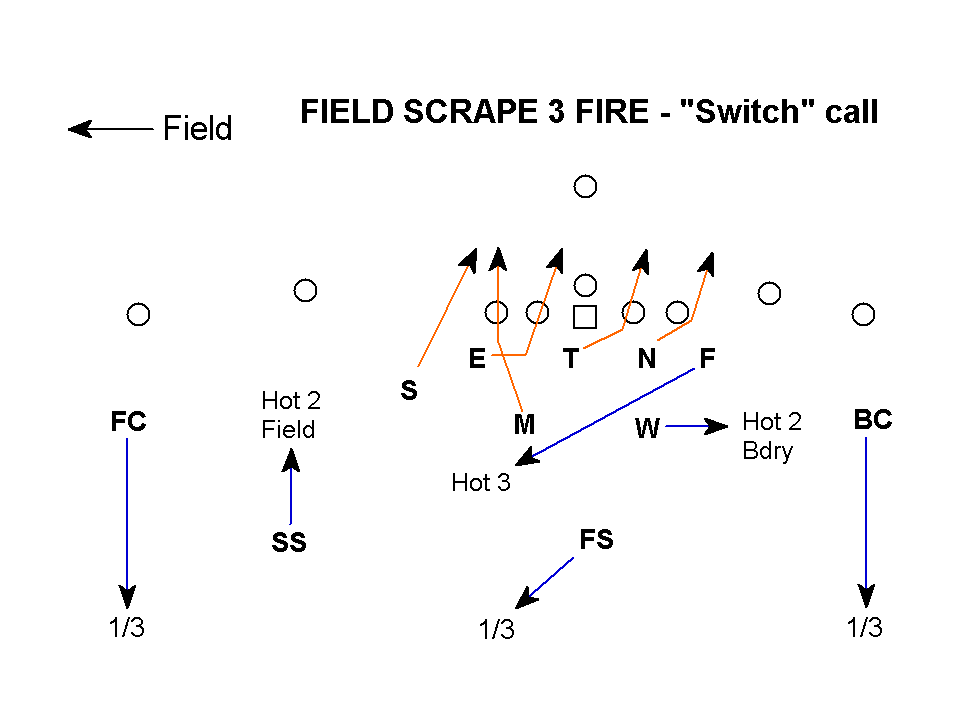
Switch - vs. 2 WRs to Boundary, Will makes a "Switch" call with DE. Now, DE is Hot 3 and Will is Hot 2 to the Boundary. Can't Switch unless #3 is in backfield.

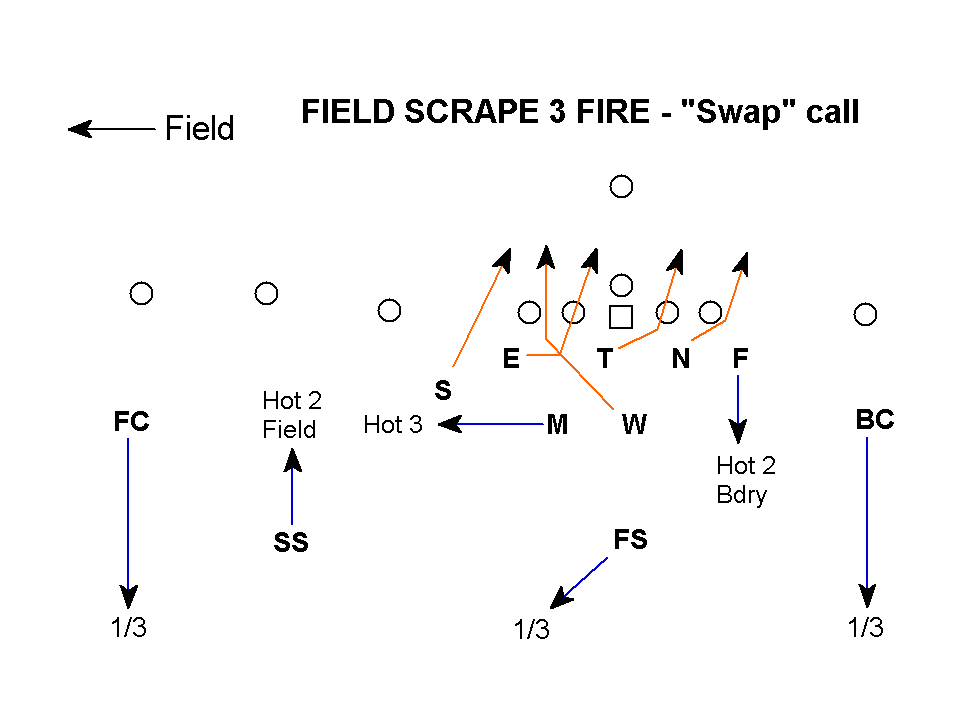
Swap - vs. 3 X 1 Trips teams that try to throw a lot of Screens, Will makes a "Swap" call with Mike. Now, Mike is Hot 3 and Will becomes blitzer.

Here is the base call, Field Scrape, from a 4-3 look:


The Offense has a mismatch with a fast WR in the boundary slot vs. a DE, so we make a "Switch" call.  You may not need this call with the ball on the hash, but it becomes more important as the ball moves toward the middle of the field.


The "Swap" adjustment is great vs. teams that like to throw quick screens or Y Stick vs. Field pressure (for more on how offenses like to use Y Stick vs. Fire Zones, go here, here, here, and here).  Mike can easily get to number 3 and it will difficult for the OL to see Will coming from the other side of the Center.


You have to be careful vs. Empty.  A "Switch" call would have the Fox DE trying to cover number 3 to the other side of the field.  It is important for your Will to know that there is no "Switch" call unless 3 is in the backfield.  There is no "Switch" vs. any Trips sets.  The only adjustment that can be made is a "Swap" call. 


Also, as my good friend, T.J. Williams reminded me, you need to practice these adjustments vs. motion from a 2x2 ("Switch" call) to a 3x1 set ("Swap" call) and vice versa so your guys aren't unprepared.


This is the "Swap" call vs. Trips:


If I can find some examples of the "Switch" call on film, I will put them up on here later.

Why so many coaches are yellers instead of teachers--they can't teach.  See here.

Senin, 10 Oktober 2011

Buck and SS Fire Zone

I've been meaning to do an article to explain this particular Fire Zone, but I will let Georgia DC Todd Grantham do it for me. He broke this blitz down on ESPN.com, and I have some good Steelers cut-ups to help illustrate the concept.


Grantham likes it as an inside pressure to get to the QB, but Dick LeBeau of the Steelers used it more often (at least in 2004) on run downs as a way to sneak in Troy Polamalu as an unblocked extra defender to stuff the inside run game.  Either way, versus the pass or run, it's an effective pressure because it's tough for the OL to pick up the SS coming from depth.


Here's video of the 2004 Steelers defense running the same Fire Zone:


Also, here is a link to Dick LeBeau's 2002 Cincinnati Bengal defensive playbook.  The Buck and SS Fire Zone actually is not in there, but you can download the picture at the top of the page.

Jumat, 15 Juli 2011

Manny Diaz Fire Zones

I will try to build on the superb efforts of Brophy’s Manny Diaz: Bulletproof Fire Zone article and talk more about Diaz's Fire Zone scheme, which is ridiculously simple to learn for his players yet is complex for opposing Offensive Coordinators.  I will focus on two important aspects of his Fire Zone scheme.  First, I will look at how he is able to transition easily between multiple fronts and second, I will explain his “run to daylight” philosophy.

Multiple Fronts

There may not seem like much of a difference between the 4-3 and 3-4 fronts, but they represent two different paradigms in the universe of defensive football.  Each front requires significant time to teach its defensive linemen the necessary technique.  The time constraints are such that most coaches don’t try to play both.  I would say that Diaz is a 4-3 guy who dabbles in the 3-4, but he doesn’t try to do too much with it, which is important. 

The 3-4 lends itself better to Fire Zones, with 4 LBs who can move around more in the 3-4 pre-snap than the 3 LBs in the 4-3.  Diaz prefers to Fire Zone from the 3-4 because the DE who drops in coverage “has eyes”—being away from the line with his hand off the ground allows him to see and better defend the pass.

Diaz has the ability to run his Fire Zones easily from either side due to his simple rules that tell the DL how to line up and where to slant to.  Diaz doesn't call a front in the 4-3 (one less word in the play call so as not to confuse his players), the DL will simply line up away from the call and slant away from the call.  Field Scrape (below) is run from the 4-3 front.  “Field” means that the Scrape Fire Zone will be run to the wide side of the field.  The DT (always on the left) and NT (always on the right) can start up head up on the Guards and then they can adjust their alignment away from the call and slant away from the call.  “Field” also tells the Safeties that they will rotate towards the Field.


In Bench Scrape (below) from the 4-3 front, the Scrape Fire Zone is now being run to the Bench, or the short side of the field (closest to the bench on the sideline).  The DL will line up and slant away from the call and the Safeties will rotate to the Bench.


East and West are Diaz’s 3-4 fronts.  West shifts the DL to the wide side of the field and East shifts them to the short side of the field.  One DE will be aligned as an OLB.  His alignment off the ball improves his vision to help him to better defend the pass.  East Field Scrape (below) is from the 3-4 front to the wide side of the field.  The DL will line up according to East or West, and then they will slant away from the call like they always do.  Field Scrape (4-3) and East Field Scrape (3-4) are the exact same thing, the only thing that changes is how the front lines up. 


West Bench Scrape (below) is the 3-4 version to the short side of the field and is the same thing as Bench Scrape from the 4-3:


Diaz can also go show a 3-3 Stack look (below), which really “melts the computers,” of opposing OCs.  He can easily go from the 3-4 to the 3-3 by making a “Freedom” call to the drop DE, which tells him that he has the freedom to line up wherever he wants.  Since he is a drop defender, he can line up as a LB.  This call only affects one player, but it totally changes the defensive  front.  This allows Diaz to run Scrape six different ways vs. opposing offenses, but it’s only one simple concept as far as his players are concerned.


Run to Daylight

The “Run to Daylight” scheme was popularized by legendary Green Bay Packer Head Coach Vince Lombardi, who told his OL to block their man wherever they wanted to go and then the RB would find the hole by “running to daylight.” 

Diaz has his DL do the same thing: instead of going to your exact gap, you “run to daylight” like a RB would.  (Note: I don’t believe Diaz doesn’t use the terminology “run to daylight,” but that’s essentially what it is).  A good example of this concept is with the playside DE in the Scrape Fire Zone (see above diagrams).  Most coaches initially teach the DE that he has the A gap.  Diaz explains it a bit differently.  He tells his DE to blitz the Guard.  This allows the DE to blitz either A gap or B gap.  He even gives his guys the freedom to work all the way across the Center into the opposite A, B, or C gap.  He will “run to daylight” and cut up into the first hole he finds, like a RB would.  This may seem not seem gap-sound, but Diaz teaches his LBs that it’s their job to make the DL right.  Diaz's defenses give up few big plays, so it works.

Diaz elaborates more on the “run to daylight” concept:

“Everybody in America runs Scrape, the difference will be in our Blitz Paths and knowing how to blitz.” 

“We are blitzing to get to the QB.  We are not blitzing gaps.”

“The offensive lineman is the worst athlete on the field—we want to make him try to change direction.”

“Blitzers are ballcarriers, offensive linemen are tacklers.  You do not run right into the guy who is trying to tackle you.” 

“Blitzer – keep working until you find grass.  We are blitzing the QB—go find the QB.”

I had a hard time finding good video on the “run to daylight” concept in the three Mississippi St. games I had, but I got some Middle Tennessee State and NFL cut-ups to help illustrate the concept:

Honestly, as I tried to figure out what made his Mississippi St. defense so good, I found that Diaz didn’t blitz nearly as much as I thought he would (teams threw a lot of screens and sprinted out while throwing the ball, so the fear and respect of the blitz was there).  He picked his spots and was very effective when he did bring pressure.  The thing that really stood out while studying the 2010 Bulldog defense were the fundamentals: excellent DL play, solid tackling from the LBs, and the DBs kept everything in front of them (don’t know why I was surprised, it’s all about fundy’s!).  I thought their Force play wasn’t very good vs. Auburn, but it was only week 2, and they still held the national champions to only 17 points.  Brophy commented that Diaz’s defense looked very “Norm Parker-esque” in the Texas spring game, which is a huge statement about their defensive fundamentals and a very good sign for Longhorn fans.

Manny Diaz’s success speaks for itself.  You don’t jump from the Sun Belt to the premier DC position / Head Coach launching pad in college football in two years by doing the same thing as everybody else—success often requires that one take risks and think outside the box.  Diaz’s ability to run the same Fire Zone from multiple fronts, his “run to daylight” concept, and his commitment to fundamentals have made his defenses extremely difficult to defend at Middle Tennessee State and Mississippi State.  I expect he will have more of the same success with some of the premier athletes in the country at his disposal, even versus the great offenses of the Big 12 Conference.


Links


A very good coach and friend of mine, Coach W, has started a blog, Becoming a Man for All Seasons.  I posted his LB Keys for the 3-3 Stack a while back and he has added diagrams to those.

Chris at Smart Football looks at John Jenkins' Houston Run and Shoot.

Deuce talks about the Tracer blitz that helped Florida dominate Ohio St. in the 2006 National Championship.

Coach Hjorth with DL Play in the 3-5.

Thanks to Coach B Dud for the shout out on the Practice Segment Timer.

Jumat, 25 Februari 2011

Triple Inside Fire Zone - Dick LeBeau


This Dick LeBeau Zone Blitz has already been talked about on Blitzology's Blog here and on Smartfootball.com here.  I liked it so much that I started digging through my video library of blitzes to find a cut-up of it.  It has 5 blitzers to attack vs. the middle 3 of the OL.  I  especially like that the blitz makes it possible to avoid the offense's two best pass protectors, the OTs. 

The picture below is a page from Dick LeBeau's playbook when he was the Head Coach for the Bengals:
2002 Cincinnati Bengals 3-4 Defense - Dick LeBeau.pdf


The Nickel will align to the passing strength and he will be the #2 Seam dropper.  Most people utilize their #2 dropper as the SCIF (Seam-Curl-Flat) dropper.  LeBeau uses a different technique for his #2 dropper, which he refers to as the Seam dropper.  The Seam dropper will have outside leverage (instead of inside leverage for SCIF technique) and he will collision and carry #2 vertical until #3 goes to the flat.  For more info on the Seam Drop, check out Blitzology's posts: Seam Drop and SCIF vs. Seam

Both DEs know they will be dropping on this play.  The Nickel will alert the DE to his side with a "Hook" call to let him know that he will be the #3 Hook dropper.  The DE away from the Nickel will be the #2 Seam dropper to his side.  The DE's rule is that he is the Seam dropper unless he hears a "Hook" call from the Nickel.  The DEs can take a step upfield to fake a pass rush to hold the OTs and keep them from blocking the DTs.  Teams also like to have personnel packages with OLB-types at DE to utilize more speed rushing the passer and for better pass coverage in Zone Blitzes like this one.

I am disappointed that I can't (yet) find any Steeler cut-ups of this concept, because none of the cut-ups below show the DTs executing the Jet B Gap technique as described in LeBeau's playbook.  The advantage to the technique taught by LeBeau is that the DTs can ideally avoid the OTs altogether in getting to their Contain rush.

The cut-ups I have found so far show the DTs working outside of the OTs.  The problem with this is that the OT can pick up the DT, which allows the Guard to work inside and pick up one of the blitzers. 

For this to be a true 5 on 3 overload inside, the DTs must avoid the OTs.  They have to jet outside past the Guards and get behind the OTs to get to their Contain rush position.  Dallas Cowboys DL Coach Brian Baker talks about this in the 2010 Atlanta Glazier Clinic notes, starting on p. 19.  He says to rush lanes, not gaps.  The two Contain rushers' responsibility is to stay outside the QB, not the OT.  His rush track is to an aiming point of 4 yards behind the outside leg of the OT.  He wants to work to the upfield shoulder of the QB (the shoulder farthest from the LOS, but not getting all the way behind the QB like Bill Belichick warns about in these notes here).

The blitzing Safety must be aligned to the same side as the Backer.  The Dime will line up as a LB to the opposite side of the Backer and blitzing Safety.  The Backer will cross first, the Dime comes right behind him and crosses second, and the Safety comes third, right off the Dime's butt.  The Safety has to hit it fast to get there from distance.
I would communicate this blitz with the call, "Wide Bench Triple Inside 3 Blaze."  Our "Wide" front has two 3 techs.  The "Bench" call has the DT, Fox DE, Will LB, and FS to the Boundary and the NT, DE, Dime, and SS to the Field.  This call will always get the FS lined up to the same side as the Will LB and allow him to blitz quickly from the near hash.  The Nickel's alignment will be independent of the Bench/Field call and he will instead line up to passing strength.

"Triple Inside" is the Zone Blitz call and "3 Blaze" coverage is a term to differentiate Fire Zone coverage with Safety rotation to the Boundary.  A Fire Zone coverage with Safety rotation to the Field would be "3 Fire" coverage.

Here's how it would look when run from the hash and here are the videos:


Field Triple Inside 3 Blaze from Barry Hoover on Vimeo.

Pretty good play call here:


Thanks to Brad who found this cut-up.  Notice the aggressiveness of the Safety, Laron Landry, in contrast to the Virginia Tech Safety in the previous cut-up.  The Safety has to hit it full speed and know that the opening will be there between the crossing LB and Dime Back.


Links:
I would highly recommend Brophy's library of Fire Zone articles:
Good article on Counter Trey from Coach Allam: http://iteachicoachiblog.blogspot.com/2011/01/run-game-counter-trey.html 
Brophy's series on Defending the Flexbone is excellent: 
Dude, is this really Jack Black?!  http://www.youtube.com/watch?v=VFJ01wRpomE

Senin, 03 Januari 2011

4-3 vs. the Oregon Spread - Fire Zones and Blitzes

I cut up all the Fire Zones and Blitzes vs. Oregon from the Boise St., Arizona, and USC games from last year.  I don't have time to diagram and talk about each and every blitz right now, but I will try to get more in-depth analysis at a later time.  Meanwhile, make sure to check out Blitzology's blog, which is back rocking and rolling again if you want to learn about the science of getting after the QB.  Some of the blitzes were ran from more than one front and I named these blitzes without naming all of the fronts as I made the video, so I hope the nomenclature police doesn't get after me too bad. 

The next post on the 4-3 Defense vs. the Oregon Spread will be on LB/Nickel play on Wednesday, Jan. 5, and it will have a full-length article to go along with the video.


Fire Zones and Blitzes
1.  Nod 3 Fire (Nickel - D gap)
2.  Bench Wanda 3 Fire (Will and Nickel)
3.  Nickel Over Cowboy 3 Fire (Corner)
4.  Odd Cow 3 Fire (Corner and Will)
5.  Bench Wham 3 Fire (Will and Mike)
6.  Bench Wham Twist 3 Fire (Will and Mike Twist)
7.  Mac 4 (Mike - A gap)
8.  Bench Nod 0 (Nickel - D gap)
9.  Bench Nod 6
10.  Bear Nam 3 Fire (Nickel and Mike)
11.  Wood 3 Fire (Will - D gap)
12.  Over Wolf 3 Fire (Will and FS)
13.  Bear Mac/Mob 3 Fire (Mike - A/B gap)
14.  Field Wolf 0 (Will and FS)
15.  Zone Blitz - LB Mistake - Bad Aiming Point


4-3 vs. the Oregon Spread - schedule of posts
Jan 1 - DL Play
Jan 3 - Zone Blitzes
Jan 5 - LB Play
Jan 7 - Defending Bash and Midline
Jan 9 - DB Play and Coverage Fundamentals
Jan 10 - (National Championship Game - Oregon vs. Auburn - 8:30 pm)

After the National Championship game, I will have an outstanding series of articles and videos with some terrific guest writers that Brophy talked about in his blog recently.