Search

Referral Banners

Rabu, 16 Januari 2008

NBA Power Rankings

The season is nearly halfway done, and I with football and college basketball, I have hardly written anything on the NBA! Time to rectify that a little with some power rankings... here is my top 10.

1. Boston Celtics - They've lost 2 in a row(!), but it's tough not to put them at the top. As of this writing, their record still stands at 30-6, and they outscore their opponents by over 11 points per game. They're efficient offensively, and they look to be the best defensive team in the Association right now. That's a nice combination.

2. Detroit Pistons - I'm tempted to put them lower after their embarrassing defeat at the hands of the Knickerbockers a few days ago, but for now they stay at 2. Their 29-10 record is 2nd best in the NBA, as is their plus 8.6 scoring margin. Even in the much weaker Eastern Conference, that's enough to put them at 2 in the rankings.

3. San Antonio Spurs - They're making it look a little harder than they have in past years, but the Spurs are still 25-11 right now. Though there is a little concern in that they are only 6-8 on the road (as opposed to a bustling 19-3 at home), which could cause some problems if they don't shape that up. I'm pretty sure they will, though.

4. Dallas Mavericks - They were on a roll until losing to the Kings on Tuesday night. Like some of the other powers in the West, they just kind of seem to be coasting along, waiting until the playoffs. Like the Spurs, they will need to get better on the road... they are only .500 right now.

5. Los Angeles Lakers - Yes, the Lakers 5th. Andrew Bynum will be out for a while, but they still have solid depth and they're playing excellent basketball, leading the Suns in the Pacific Division as of this writing. Obviously Kobe is the catalyst here, but they have a plethora of guys contributing every night. It would appear the young guys have finally grown up around Kobe, which makes this team very dangerous. Don't look now, but the Lakers are quite potent offensively, averaging a robust 107.8 PPG.

6. Phoenix Suns - They're still the most fun team to watch, but they're struggling a bit more this year, relatively speaking. They're still 26-2, but they give up nearly 105 PPG (again, part of the pace they play), and they're still not getting enough contributions from their bench. Steve Nash is once again playing 34 minutes per contest, which will hurt later in the year. With Grant Hill out a little while longer, the bench will be even more thin... not good.

7. New Orleans Hornets - Led by Chris Paul (who has potentially morphed from the 2nd best PG in the NBA to a top 5 NBA player), the Hornets can beat anyone on a given night. People do not appreciate how good this guy is... he has surpassed Steve Nash as the best PG in the NBA, and is making a viable case to be the MVP of the NBA. You can't say enough about Chris Paul.

8. Utah Jazz - The Jazz are finally starting to play better basketball, having won 4 in a row to stand at 22-17. They have a very solid 4.0 plus scoring margin. This is the amazing thing about the West... at 22-17, if the playoffs started today, the Jazz would be on the outside looking in. In the East, they would be a 4 seed.

9. Golden State Warriors - The craze of the NBA last June, the Warriors struggled out of the gate this year. However, they appear to have found their stride once again under Don Nelson, and now sit at 23-16. As long as Baron Davis is healthy, they can potentially (as they have shown) beat anyone in a 7-game series.

10. Orlando Magic - They have cooled down considerably after their hot start, but they still look the be the 3rd best team in the East (granted, a long ways off from the top 2). Dwight Howard is averaging 15 rebounds per game right now. They are worth the price of admission if only to see that man rebound the basketball.

Your thoughts? What would you change around?

Minggu, 13 Januari 2008

Why UCLA is better this year than last year

It seems like a strange thought... UCLA has gone to back-to-back Final 4s, and after each season they lost a guard in the first round of the NBA Draft. But this is still the best team UCLA has had since Ben Howland got to UCLA.

First of all, this is a tribute to Howland and his system. His emphasis on defense obviously works (for proof, just watch the first half of Saturday's game against #4 Washington St). The Bruins are disciplined and quick defensively. They are not the most talented team in the country right now (not that the cupboard is bare, obviously), but that doesn't preclude them from being considered possibly the best team in the country.

But there are 2 main reasons why I think this year's version of UCLA is better than the past couple of seasons:

1) Kevin Love - Obviously, the hype coming into the year was huge. He was a top 3 prospect, seen as one of the most polished big men to enter college in a long, long time. He has certainly lived up to the hype, looking like he might be the best player in the Pac-10 already. On Saturday he scored 27 points, grabbed 14 rebounds, doled out 2 assists, and blocked a couple of shots. He even knocked down a pair of 3-pointers for good measure. On the season he is averaging nearly 17 PPG, 10 RPG, and a couple of assists.

He has an extremely well-balanced game. He can score on the block. He commands double teams, and this opens things up for everyone because he is one of the best passing big men in America. He's very efficient, shooting over 60% from the field (and 8/22 from downtown) and over 78% from the stripe. He is always in control, as rarely has he gotten into foul trouble. He is one of, if not the best big man in the country. Already.

2) Russell Westbrook - This is the overlooked reason for why UCLA has been so good. The injury to Darren Collison to start the season was a blessing in disguise, as it has allowed Westbrook to become a very prolific contributor in his second year for the Bruins. He has now moved to the bench, where he might be the best 6th Man in America. He is averaging 12 PPG, and is leading the Pac-10 in assists with over 5 per contest.

But the numbers don't tell the whole story. He provides another ballhandler to complement Darren Collison. Defensively, he is very quick. He is very tough on the ball, and has quick hands, which is why he averages 1.5 steals per game. At one point on Saturday he picked the ball right from Kyle Weaver and went all the way for a dunk. Even more, Westbrook provides another guy that can be an athletic wing alongside Josh Shipp. He's a solid outside finisher, but he's also strong enough to finish inside. His versatility adds another element to UCLA... he can play the 1 or the 2, and he affects the game so many ways on both ends of the court.

Your thoughts? Is this just homerism? Or is this the best version of the Bruins we have seen so far under Ben Howland?

Rabu, 09 Januari 2008

My College Basketball Top 10 - 1/09/08

Time to give me top 10 in the world of college basketball. This is not based solely on achievement, but also how good I think the teams are right now. It was based solely on achievement then all of the undefeated teams would have to be on top, which is not the case. Anyway, that's neither here nor there. My top 10:

1. Memphis - They have been the most impressive team to me so far this year. This is a few weeks back now, but I thought their win over Georgetown might have been the most impressive win for anyone this year. The way they took apart an excellent team like the Hoyas in the 2nd half was a sight to see. They struggle still in the halfcourt offense, but they are more athletic than any other team, and this allows them to get up and down the court. It also allows them to be a very, very good defensive team. They're tough.

2. North Carolina - Obviously you can't complain about a perfect record, I just think the Tigers are a little better. The loss of Bobby Frasor hurts, as they already struggle some with shooting the basketball from the outside. Still, they have the depth and explosiveness to make a run to the title.

3. Kansas - They have been playing excellent ball, and should only get better as Brandon Rush and Sherron Collins continue to get healthier and better. They have 9 guys that play at least 10 minutes a game. Oh yes, there is lots of depth for the Jayhawks.

4. UCLA - They are behind Washington St. in the polls, but I think they're the better team. They had a bad game against Texas, but that neutral court win against Michigan St. (without Darren Collison or Michael Roll) is starting to look better and better. With Kevin Love averaging a double-double right now, he looks to be a strong contender for Pac-10 Player of the Year.

5. Georgetown - They will probably struggle against teams like Memphis, who play fast and have a big, physical guy to guard Roy Hibbert. But the Hoyas are a surprisingly versatile, talented team. As the excellent freshmen guards continue to get comfortable at the college level, the Hoyas will continue to improve and become more explosive.

6. Michigan St. - I like them a lot. They are great defensively under Tom Izzo. Drew Neitzel hits as big shots as anyone in America, but the little known secret is that Raymar Morgan is their best player. Like many teams near the top, they will continue to get better and better, as they play a lot of freshman that are just getting experience.

7. Washington St. - They remain undefeated, but they are very low on quality wins, which is why I have them down at 7th. But they'll be a tough out. They play great defense, and because of this they are able to slow the game down and make you play at their pace. Just a solid team that doesn't beat themselves.

8. Tennessee - They can beat anyone when their shots are falling, and they can lose to anyone when their shots are not falling. They are obviously extremely difficult to play against because of their fast-paced style. They do not allow teams to get comfortable on either end of the floor, meaning the opponent has to be very disciplined mentally to stick with the Volunteers. Most teams are not.

9. Duke - They have depth and an underrated amount of athleticism. 9 guys play at least 11 minutes per contest, and at least 6 score 8.8 per game. Their trio of Nelson-Singler-Henderson is very athletic, something they really lacked last year. They are well-coached, and can challenge UNC in the ACC.

10. Texas - I'll give them the final spot, though they have been struggling a little of late. DJ Augustin may be the best PG in the country, as he seems to be able to get into the lane at will and get a shot anytime he wants. We know what they have in AJ Abrams, one of the best pure shooters in America. Like last year, Texas' fate rests in the hands of the "other guys," players like Damion James, Connor Atchley, and Justin Mason. They will determine how far the Longhorns go.

Your thoughts? What changes would you make?

The Divide Route in the Multiple Smash Concept

The "smash concept" is extremely popular for a reason: It's a great route. And it is simple to teach. The concept is designed to defeat Cover Two in its many forms. As Cover Two has evolved (Tampa 2, "Tough Two" with the corners retreating to ten yards and jumping routes, and Cover Two-Man), the Smash has become more and more popular.

A word here about verbiage. I refer here to the "Smash concept" or the "Smash route." Both refer to a two-man combination with the outside receiver on a 6 yard hitch and the inside receiver on a 12 yard corner route. Some coaches and teams go further and actually refer to either the corner route or the hitch route as a "smash" route. Again, "smash" to me is the combination - i.e. the concept - rather than any individual route.


In any event, the quarterback has a progression read: (1) corner, (2) hitch underneath. In his progression read he will "key" the cornerback: If the cornerback sinks back to stop the corner route, throw the hitch; if he comes up for the hitch, throw the corner. The best way to describe this to a QB is that you have a progression read and you "read" your receivers. You simply "progress" from one to two. In doing this though you have to understand what guys you are "keying," as their reactions should determine your progression. A Quarterback must understand defenses and defender reactions, but at the same time there is no telling where those 11 guys on defense will go, and as long as he knows where his receivers are and if the QB and the receivers are all on the same page we can run a successful play. We tell him his general rule is to throw the corner route until they take it away (though by gameplan or defense you can tell him to always throw the hitch until they come up for it).

I won't belabor the details of coaching up the "smash" portion of the route itself. If you want to understand all the details in depth, I suggest this. See here too for more on the "multiple smash route." (Registration required) Broadly, the inside receiver will run a 12 yard corner route. He has no "reading" on the play, but he must know his techniques. First, he should identify whether it is man or zone. Against man he will need to close his defender's cushion, push or lean him slightly inside, and plant and break hard away from the defender. Against zone he wants to see who he is running the route off of. If there is a deep defender over him he must set this man up inside and jab at the post at 10-12 yards and break for the corner. If there is no one head up on him he will roll cut his route so he loses no speed. It's worth mentioning though that even if he jabs or plants and breaks we want this closer to a "speed cut," as we don't want him to lose too much speed. A receiver can do this best by "jabbing" while having his toes actually pointed where he wants to go and having his "plant" foot not outside the framework of his body. Young receivers too often step way outside their body frames with their toes pointed in the wrong direction.

The corner route will be caught between 22-25 yards downfield. The QB's job is to "throw him open": throw the ball into the open grass. The receiver must react to the ball and go and get it. Against man to man defense to the short side of the field the depth of the route will be 18-22 yards.

See the above linked article for more specifics, but we tell the outside guy he has two portions to his route. First, run a six-yard hitch route (five-steps - three big and two small), and (2) the "option" or "get open" part of his route. We simply want him to find the open spot. If the corner comes up in Cover 2 zone he will push to 6, turn inside, and work inside to the next zone hole.


If the corner is off and he turns and there is a flat defender inside, he just wants to get space from that guy. If that defender hangs the hitch receiver will drift away from him at his 5-6 yard depth as an outlet for the QB.


If the flat defender flies out to cover him he will break inside this player. We'd like him to actually climb over this flat defender because he will better be able to find the zone hole created but if the flat defender hangs back too far he will come inside slightly and settle underneath.


The Divide Route

This is all fairly straightforward stuff that most people do. The point of this article is to talk about adding a bit more of a big-play dimension to theSmash by using the "divide route," which in other coaches terminology may be a "seam read" or a "tube-read." Both the route and the "read" are simple.

The divide route involves a MOFO or MOFC read by the inside receiver. MOFO simply means "middle of the field open," or no deep middle safety. MOFC means "middle of the field closed," or is there a deep middle guy. The nice thing about this read for the "divide route" as opposed to some other contexts is that the route, hence the name, is simply about "dividing" the deep coverage and the receiver has a lot of freedom to find the downfield open grass. It's a deep stretch and it is designed to strike safeties who overplay the smash or simply get out of position.

Obviously the immediate strength of the divide route as shown is that if a two-deep safety to the smash side overplays the route, one can hit the post route for a big play. If you keep the go route on the backside (as diagrammed) and both safeties overplay the Smash side then the "Go" might be open for a big play. The simple reality is that a Cover 2 team really cannot cover this concept effectively.

Against a Cover 3 zone the QB's "peek" is the seam backside. Before the smash part of his progression, he wants to get the F/S moving and hit the seam.


Running the divide to the trips side is even more dangerous. Any team that tries to play Cover 2 to the trips side will struggle mightily. Many defensive coaches instruct their kids to simply check out of Cover 2 against a trips look. Observe that the "divide" principles governing that inside receiver tells him that he will run more of a "skinny" post here inside the Cover 2 safety to break the deep coverage but avoid the safety on the opposite hash. If there is no deep safety the receiver has lots of freedom.

This is because, again, the governing principle of the "divide route" (one reason I like to call it this instead of a "seam-read") is that you can largely just tell the receiver that he has the area between the hashmarks to work to find the deep open vertical grass. A more advanced technique applies if the defense drops super deep so that he cannot effectively "divide" defenders. This will be done by gameplan, but if that is the case we will essentially let him "throttle" down a bit in the voids and the QB will still look to throw it in the open grass, but simply in the open grass in front of those deep dropping safeties.

In any event, see below for how the divide route will work against MOFO and MOFC defenses.

Cover 2:
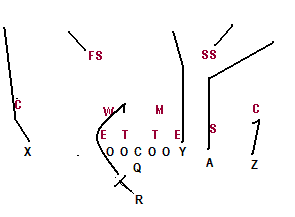


Cover 3:


Now, what if it is a MOFC defense but that free safety is flying over too much? Well now it's time to be a good Ball Coach and tag the inside receiver on a "middle-read" route. I have previously explained that route here. The similarity with the divide is a post route against MOFO. The difference is a square-in or cross against MOFC. So if that free safety flies over, he will cut inside that guy. Observe that this is the exact same principle we used for that outside hitch receiver.


Backside hitch

Here is a last aspect to the play that I am a big fan of. I think the play is very effective if you keep the backside player on a hitch, particularly in trips. This gives you a great look against any soft coverage. When you do this you ask your QB to be a ball player and get the ball to the backside receiver if the defense gives it. (In other words, it's probably soft Cover 3.) If it's not there he looks over to the smash side and works his normal progression: Peek at the divide route, then work the smash combination.


Conclusion

This is a simple, well designed play that is both a ball-control, high percentage play, but with the divide route and the corner route it has great big-play potential. If the defense plays soft you will take what they give you, but if they play any kind of two-deep or if their safety gets out of position you will make them pay.

Kamis, 03 Januari 2008

Orange Bowl Preview

In his BCS Preview my esteemed colleague remarked that the game doesn't excite him all that much. As a Kansas fan, I must disagree. The first BCS game for the Jayhawks should be quite a show.

Kansas has one of the most explosive offenses in the country. Sophomore quarterback Todd Reesing has thrown for 3,259 yards and 32 touchdowns. Senior RD Brandon McAnderson has ran for 1050 yards and 16 TDs, while backup Jake Sharp has ran for 788 yards. The Jayhawks average just over 44 points per game.

However, they haven't quite faced a team with a defense like Virginia Tech. Their rush defense ranks 5th in the nation, allowing just 86 yards per game. One interesting match up will be to see how Va Tech's secondary matches up with KU's receiving corps. Kansas will spread the field, with 4 or 5 wideouts, and while Va Tech should have the talent to cover Kansas's top wideout Marcus Henry, Kansas's 4th and 5th wideouts should be able to get open enough. One player to look for is Kerry Meier, who in his spare time is Kansas's backup QB. One interesting note is that Virginia Tech outscores its opponents 103-44 in the first quarter.

While my head says that Virginia Tech is probably the better team, I can't pick against the Jayhawks and the new Mangenius. Kansas 31, Va Tech 21

If I may send out a quick shameless plug, I started a blog at www.100percentsports.blogspot.com mostly featuring baseball talk, but there will also be a lot of college sports, and maybe even some soccer if I feel so inclined. So if you like my posts here come check it out, or even if you don't and just want to make fun of me that's ok too.

Selasa, 01 Januari 2008

Lloyd Carr Goes Out a Winner. Plus NHL, Outdoors Style


In what many people must think is a big upset, the Michigan Wolverines defeated Tim Tebow and the Florida Gators in the Capital One Bowl. Chad Henne had a career day, throwing for 373 yards and 3 TDs, while Adrian Arrington caught 2 of them.

The Michigan defense pressured the Heisman winner all day, knocking him down repeatedly. While Tebow did throw for three scores, the last drive was representative of what was happening all day for the Florida offense. Scrambling around, Tebow was forced to heave up a pass that landed incomplete and ended the game and the season for the Gators.

Granted I'm a Michigan fan, but speaking as a college football fan in general, I'm very happy to see Coach Carr go out with a win. While he didn't have his best year this year, hopefully he will be remembered as a class act and a coach who truly cared about his players not just in football terms, but as people also.

In the other big story of the day, the Pittsburgh Penguins and Buffalo Sabres tangled in Ralph Wilson Stadium. The second outdoor game in NHL history was hockey at its finest, a chilly snowy day that I'm sure reminded many players and fans alike of when they used to play on the pond. Watching NHL players play even when snow was covering the ice and affecting the puck made me realize just how skilled these players were. The face of the NHL, Sidney Crosby, had an assist on a Colby Armstrong goal just 21 seconds into the game, and also scored the game winning goal in the shootout.

The NHL is planning a game to take place indoors at Ford Field along with a college hockey game to prep for the Frozen Four which will be in Detroit in 2010.

Happy New Year!

Happy New Year to everyone!

I will be out of town until early next week, meaning I won't be able to post. (Mr. Fetch, if you're willing and able to post, by all means, have at it).

So have a good New Year, and see you next week!